
Menu Engineering REIMAGINED
Transform your menu from a passive catalogue of dishes into a dynamic, strategic tool that drives efficiency, transaction value and customer experience through Menu Architecture (MA)
DECONSTRUCTING FRAMEWORKS
IVAN BREWER
1/12/20267 min read
EXAMPLE
You’ve got a dish running 48% food cost. Menu Engineering (ME) says cut it or reprice it. But remove it and your average check drops $12, because the dish segues into a glass of matching wine, and that one change has changed everything - an item added to the high performance scale, means another dropping out.
Menu Engineering, is one of the most misunderstood and followed of all Hospitality Frameworks
And is, at best, incomplete. And is, at best, incomplete. At worst, a pathway to failure.
It optimizes parts of a system, discreetly and independently. Treating each dish as an isolated profit center, ignoring the interdependencies between dishes that collectively drive perception, choice flow, and overall check value often destroys the relationships that generate real revenue.
How we got here
Traditional ME, developed in the 1980s, worked for franchise-style environments, built for standardized, throughput-driven hospitality models (chains, QSRs, volume dining).
It views itself the “menu” as a catalogue - a disparate collection of individual dishes, each judged both solely and against other items, on its margin and popularity.
Traditional ME assumes
price-based anchoring,
assumes stable data inputs (consistent costs, demand, and margins),
stable supply-chains,
no seasonality and
consistent consumer choices.
Menu Engineering 2.0 - Introducing Menu Architecture
In practice, modern menus behave as interdependent ecosystems:
Anchor items (e.g., a high-end steak) justify the price of mid-tier items (“credibility dishes”).
Throughput dishes simplify choices and protect operational speed (“accelerator dishes”).
Companion items (sides, drinks, desserts) depend on main choices (“basket builders”).
Product and ingredient choices are part of the “theatre” and experience of the restaurant, their provenance intertwined with the menus narrative and overall business strategy.
Three limitations of Traditional Menu Engineering
System Interdependence is leveraged
Menu Architecture uses:
A low-margin but visible “anchor” dish (e.g., $15 pasta) makes the $28 main look reasonable.
A low-cost “companion” side (e.g., $6 fries) boosts check size and satisfaction.
Removing a dish that “doesn’t perform” may reduce the “effectiveness” of nearby items.
Dish value is relational, not individual.
Guest Behavior is Multi-Item
Guests rarely interact with just one dish. They:
Browse, compare, discard.
Look for validation (e.g., chef's pick, crowd favorite).
Pair items (wine + entrée, appetizer + main).
Optimizing for individual items misses the guest journey and basket-building logic
Throughput, Mood, and Cognitive Load are Interdependent
Some items aren't profitable on their own, but:
Create staged opportunities for “upsells”; a matched wine, for example.
Speed up decisions by being simple and familiar.
Reduce pressure on kitchen bottlenecks.
Create mood continuity or story flow.
Example
A 180-seat Brisbane restaurant ran quarterly menu engineering and flagged house-made gnocchi as a “puzzle” (mid- popularity, 36% food cost). They removed it.
Before: Average check $87; table turn 78 minutes; ~340 covers on a Friday.
After removal: Average check $79; table turn 84 minutes; ~315 covers.
Mechanism: The gnocchi was a trust signal. Guests who ordered it as a starter were twice as likely to choose premium mains and three times as likely to add wine. Without it, guests defaulted to safer, lower-cost selections. And, the gnocchi was VERY fast to make.
Response: They reinstated the gnocchi, positioned it as a “Kitchen Specialty,” and decision confidence returned. Average check recovered to $91; turn time fell to 76 minutes.
Operator playbook - How to transition from Menu Engineering to Menu Architecture
Owner/GM — This week (2–3 hours)
Pull the last 90 days of POS data. Identify dish pairs and trios that appear together in above-average checks.
Map “anchor items” (ordered alone) vs “companion items” (drive add-ons).
Compare average check for transactions that include each item vs those that don’t.
Done when: You have a relationship map (not just margins) for key items.
Owner/GM — following 7 days (4–5 hours)
Track table turn time by selection patterns (e.g., pasta + fish vs fish alone).
Measure decision time from menu handoff to order placement for current layout.
Log the customer questions that cause decision friction; note which dishes trigger them.
Done when: You know which items accelerate decisions and which create drag.
Head Chef — Next 14 days (6–8 hours)
Classify dishes by technique intensity and credibility signal to guests.
Estimate actual labour per dish (prep, plating, section load, docket management).
Test one small-variance menu where a “weak” item is removed; measure the impact on basket value and premium uptake before making permanent changes.
Done when: You can state which “low-margin” dishes make high-margin dishes credible.
FOH — Next 30 days (ongoing)
Recognise cross-sell sequences (which starters lead to which mains/drinks).
Develop concise prompts that reduce paralysis without hard-selling.
Gather feedback on menu clarity and category coverage; report weekly to BOH/GM.
Done when: Floor teams guide decisions using relationship knowledge, not margin scripts.
Things You Should Know - in summary
Where we started: The Kasavana & Smith (1982) menu engineering matrix (Stars/Plowhorses/Puzzles/Dogs) suited standardised franchise contexts with stable demand and assumed isolated, rational item decisions.
What’s changed: Dining choices operate through relationships - credibility, coherence, and perceived value across the menu. A dish that looks “unprofitable” alone may be essential to sell higher-margin items, increase add-ons, or speed decisions.
The shift: Move from menu engineering to menu architecture - designing item relationships and choice pathways that maximise total transaction economics and throughput.
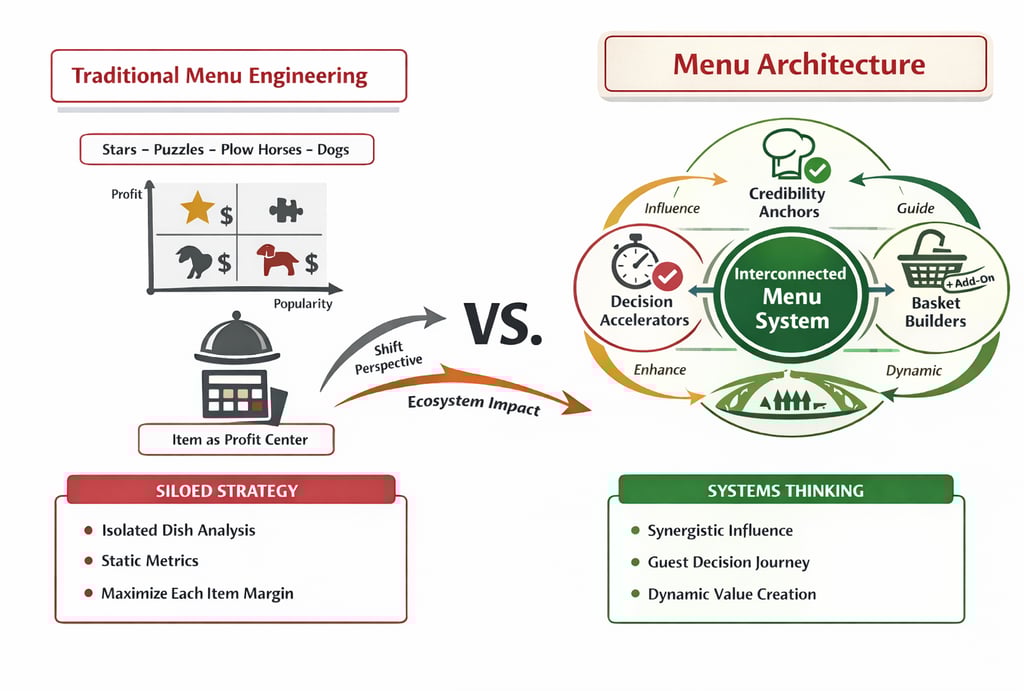
Your menu is a deeply interconnected and complex system, with seen and unseen relationships between menu items that drive efficiency, transaction value and experiences.
A high-performing menu is not simply a list of well-performing items; it is an integrated ecosystem where every component interacts with and enhances the value of others.
This systemic approach recognises that the true power of the menu lies in the synergy between its parts.
Because traditional ME was not conceived to serve modern restaurants.
To truly unlock the potential in your menu, it is critical to shift this perspective from engineering a list, to designing a system.
When seen through the lens of Menu Architecture, a menu’s economic performance is non-linear - removing one “low-margin” dish may collapse an entire network of complementary sales or distort perceived value tiers.
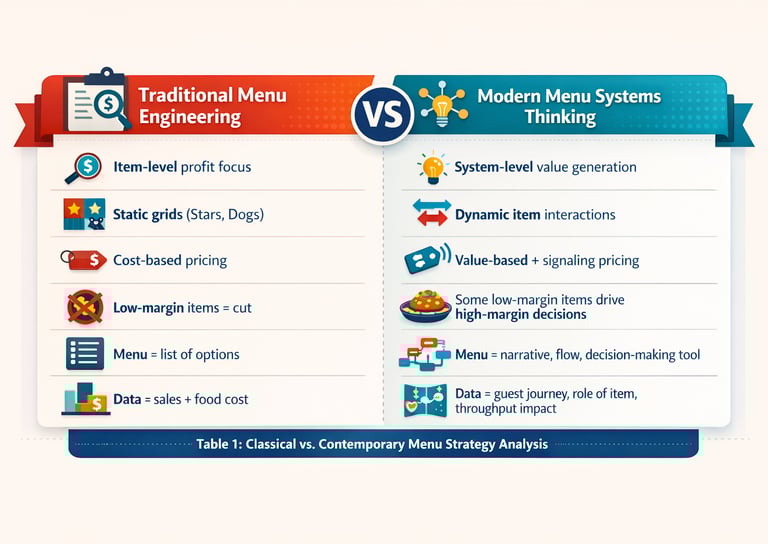
The pathway to profit isn’t found in a 2x2 matrix - it’s about flow, speed and experience.
Some dishes create credibility that makes premium choices viable. Some accelerate decisions and protect throughput. Some are strategic levers waitstaff and bar staff can utilise to maximise both customer experiences and service outcomes, and Others are companions that lift basket value.
The question isn’t “Does this dish hit margin targets?” It’s “What role does this dish play in total transaction economics?”
TL;DR Summary
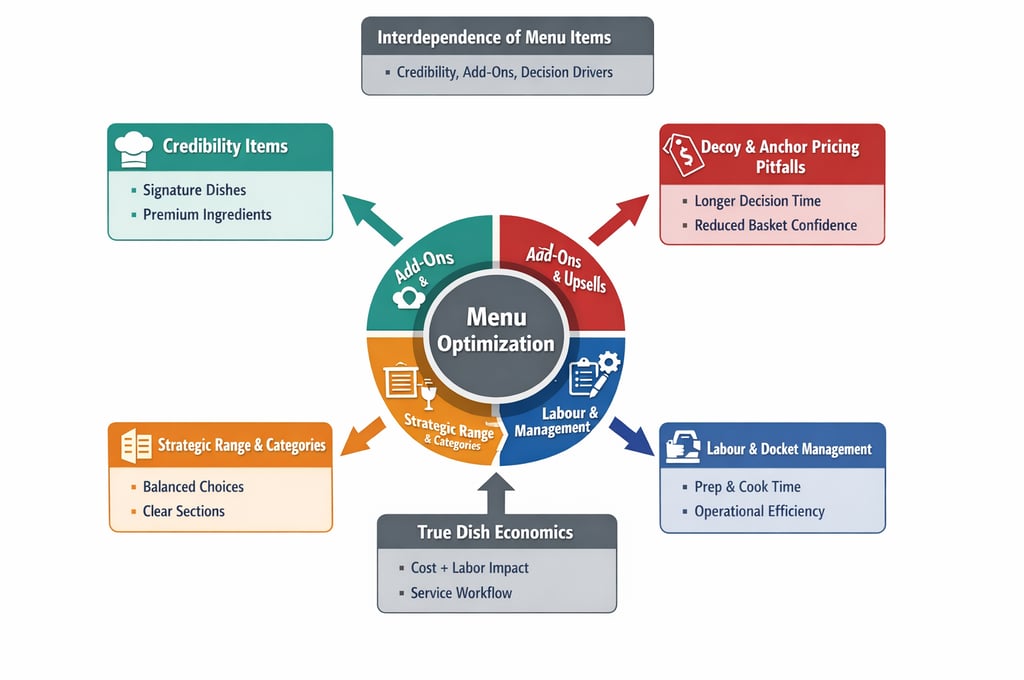
Menu design must move beyond profit-per-dish metrics. It should incorporate behavioral psychology, trust, operational constraints, and strategic design principles to optimize performance and guest satisfaction. Credibility, clarity, and category structure are just as crucial as cost and price.
Research Breakdown
The Flaw of Classic Menu Engineering
Traditional Focus: The Kasavana & Smith (1982) model treats each dish as an isolated profit center, prioritizing individual profitability and popularity metrics.
Limitation: This fails to account for interdependencies among items and their varied roles in influencing guest choices.
Strategic Roles of Menu Items
Dishes serve functions beyond direct profit, driven by consumer psychology and behavioral economics:
Credibility Builders: Items that signal quality or expertise (e.g., chef specials, use of premium ingredients).
Add-on Drivers: Items designed to increase the total check average (e.g., sides, beverages, desserts).
Decision Accelerators: Familiar, known items or clear value propositions that simplify and speed up the ordering process.
Navigating Pricing Psychology Risks
While techniques like Decoy and Anchor Pricing are used to steer choices, they can undermine guest confidence if perceived as manipulative:
The Pitfall: When guests perceive a lack of trust or logic in pricing, it can lead to:
Slower decision-making.
Lower confidence in selections.
A reduction in overall spend per visit.
Optimized Menu Structure and Category Design
Effective menu design requires balancing complexity and choice:
The Balance: Avoid choice overload (paralysis) while ensuring adequate range for effective price discrimination.
Strategic Range: The menu must not be too narrow (limiting appeal) or too wide (creating confusion).
Clarity: Clear category segmentation is essential for streamlining guest choices and price tier comprehension.
True Dish Economics: The Operational View
Accurate profitability analysis must extend beyond just food cost and selling price to include operational factors:
Labour Cost: Factor in the time and skill required for prep and execution.
Docket Complexity: Assess the impact of the dish on kitchen flow, efficiency, and ticket times.
Further Reading and Supporting Literature (by no mens exhaustive)
Here are sample list of 10 scholarly and high-quality sources that support and expand on the ideas presented:
Kasavana, M.L., & Smith, D.I. (1982). Menu Engineering: A Practical Guide to Menu Analysis.
Foundation of classic menu engineering (popularity × profitability quadrant model). [Original framework]
McCall, M., & Lynn, A. (2008). The effects of restaurant menu item descriptions on perceptions of quality, price, and purchase intention. Journal of Foodservice Business Research, 11(4), 439–445.
Shows how menu item framing affects credibility and guest behavior.
Kimes, S. E., & Wirtz, J. (2007). Perceived fairness of revenue management in the restaurant industry. Journal of Revenue and Pricing Management, 6(4), 332–344.
Supports the idea that pricing credibility affects customer trust.
Bujisic, M., Hutchinson, J., & Parsa, H. (2014). The effects of restaurant attributes on customer behavioral intentions. International Journal of Contemporary Hospitality Management, 26(3), 517–534.
Touches on how non-price attributes (service, labor visibility) affect dish value.
Pavesic, D. V. (2005). Menu engineering: A lost art and science. International Journal of Hospitality & Tourism Administration, 6(3), 1–18.
Critiques oversimplification in menu engineering and advocates a broader view.
Hsee, C. K., & Rottenstreich, Y. (2004). Music, pandas, and muggers: On the affective psychology of value. Journal of Experimental Psychology: General, 133(1), 23–30.
Related to affect and anchor pricing; why emotional credibility matters.
Iyengar, S. S., & Lepper, M. R. (2000). When choice is demotivating: Can one desire too much of a good thing? Journal of Personality and Social Psychology, 79(6), 995–1006.
Classic study on choice overload; supports the need for strategic range.
Sulek, J. M., & Hensley, R. L. (2004). The relative importance of food, atmosphere, and fairness of wait in restaurants. Cornell Hospitality Quarterly, 45(3), 235–247.
Adds nuance to understanding of labor and kitchen factors in guest satisfaction.
Wansink, B., & Love, K. (2014). Slim by design: Menu strategies for promoting high-margin, healthy foods. International Journal of Hospitality Management, 42, 137–143.
Discusses menu item positioning to drive desired outcomes.
Simonson, I. (1989). Choice based on reasons: The case of attraction and compromise effects. Journal of Consumer Research, 16(2), 158–174.
Decoy and compromise effects explained, relevant to menu psychology
But, a menu truly succeeds when seen as an ecosystem of interdependent psychological, operational, and synergistic forces.
Not in isolation, and based on thresholds noone can even agree upon.
Facts over Folklore - insights that you can use today
Join over 1100 operators recieving weekly insights